
Throne Room of Knossos: Europe’s Oldest Throne & Griffins
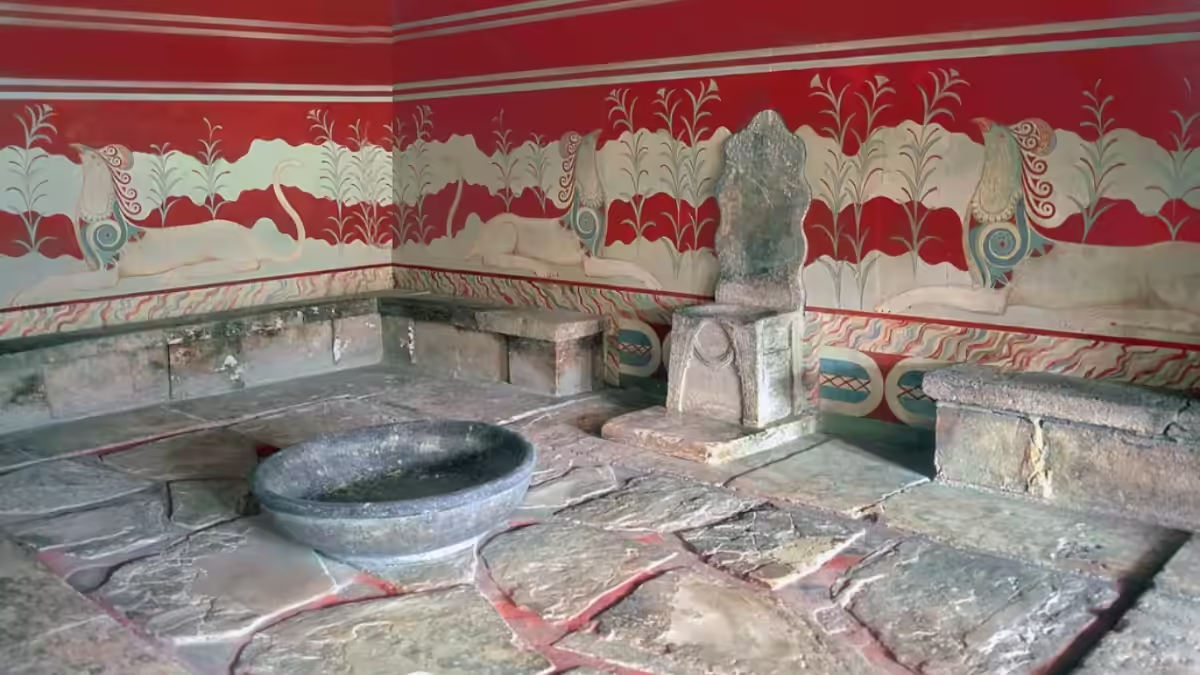
The Throne Room at Knossos is a small chamber off the Central Court holding a carved gypsum seat often called the “throne of Minos” — widely described as the oldest throne in Europe, around 3,500 years old. It is flanked by replica griffin frescoes and faces a sunken lustral basin. You view it from a barrier at the doorway rather than walking inside.
Of all the rooms Sir Arthur Evans uncovered at Knossos, none captured the public imagination like the Throne Room. A stone seat still stands against the wall where it was found in 1900, guarded by painted griffins, in a chamber that feels almost intact after roughly 3,500 years. Evans named it for King Minos, and the label has stuck, even though we cannot say for certain who — or what kind of figure — actually sat here.
This guide explains what you’re looking at: the gypsum throne itself, the griffin frescoes flanking it, the sunken lustral basin opposite, the room’s likely ceremonial function, and how to see it now that it is roped off from visitors.
The Throne Room at a Glance
| Detail | Throne Room |
|---|---|
| Location | West wing, off the Central Court |
| The throne | Carved gypsum seat, high wavy back |
| Age | Around 3,500 years old |
| Frescoes | Griffins and reeds (replicas on site) |
| Facing feature | Sunken lustral basin |
| How you see it | From a barrier at the doorway |
The Throne of Minos
The throne is a single high-backed seat carved from gypsum, set against the north wall of the room with stone benches running along the walls beside it. It is frequently called the oldest throne in Europe, dating to roughly the 15th century BC. Evans linked it to the legendary King Minos, but there is no proof a king sat here; a priestess or a ritual role is just as likely.
The throne is cut from a single block of gypsum, a soft local alabaster-like stone, with a tall back that curves in a wavy, almost leaf-like silhouette. It sits low to the floor between plastered walls, with narrow stone benches flanking it where perhaps a dozen or so people could have sat facing one another. Because it survived in place, it is one of the few pieces of Minoan furniture you can see exactly where it belonged.
Whether it belonged to a “king” is another matter. Evans’s Minos was part scholarship and part romance, drawn from the myth of the Minotaur and the Labyrinth. Many archaeologists now read the seat as a ritual chair for a priest-king or a high priestess presiding over ceremonies, rather than a political throne in the modern sense.
The Griffin Frescoes
Two pairs of griffins — mythical lion-eagle creatures — flank the throne, painted couchant among tall stylized reeds and lilies against a red-and-cream background. What you see on the wall today is a reproduction; the surviving original fragments are held in the Heraklion Archaeological Museum. The griffins are guardian symbols, reinforcing the sacred, protective character of the room.
The painted griffins lie facing the throne, one pair on each side, their bodies stretched among papyrus-like reeds. In Minoan and wider Bronze Age art the griffin is a guardian, a hybrid of lion and eagle associated with divine authority — exactly the kind of imagery you would expect around a seat of ritual power. The composition is symmetrical and calm rather than fierce, which is part of why the room reads as ceremonial rather than martial.
As with every wall painting on site, honesty matters here: the vivid griffins are replicas. Evans’s team reconstructed them from fragments, and the surviving originals and other Minoan frescoes are displayed in the city museum. Seeing the reproduction in place and then the fragments in Heraklion is the fullest way to understand them, which is why some visitors buy combined Knossos and museum tickets.
The Lustral Basin
Directly opposite the throne, the floor drops into a small sunken rectangular area reached by a short flight of steps — what Evans called a “lustral basin.” Similar sunken basins appear elsewhere in the palace and at other Minoan sites, and they are generally interpreted as spaces for ritual purification or anointing rather than ordinary bathing, since several had no obvious drainage.
Standing at the barrier, you can see how the throne, the benches, the frescoes and the basin were designed as one composition: a person on the seat faced the sunken basin across the room, framed by guardian griffins. Whatever ceremony took place, water or oil and the act of descending into the basin seem to have been part of it. The residential quarters across the palace show the Minoans understood plumbing well, as the Queen’s Megaron and its drainage makes clear, so a basin left deliberately without drainage points to ritual, not practicality.
Ceremonial and Religious Function
The Throne Room sits in the west wing of the palace, the side most associated with storage magazines, shrines and administration rather than daily living. Its position, its restricted size and its symbolic decoration all point to a religious or ceremonial role. Only a small group could gather inside at once, suggesting exclusive rites rather than public audiences.
The Minoans left no readable historical account of what happened here — their Linear A script and their wider culture remain only partly understood — so interpretation rests on the architecture and the imagery. What is clear is that this was a controlled, sacred space at the heart of a palace that was as much a religious and economic center as a royal residence. An anteroom in front, with its own bench and a wooden throne copy, screened the inner chamber from the courtyard.
Viewing the Throne Room Today
You cannot enter the Throne Room. It is roped off and viewed from a barrier at the doorway off the Central Court, so you look in rather than walk through. Arrive early, because the narrow viewing point creates a bottleneck when coach groups gather, and the light inside is dim. There is no queue system for the barrier itself, so patience and timing help.
To protect the fragile gypsum and plaster, the room is closed to foot traffic; a wooden barrier across the entrance lets you look in from the anteroom while keeping everyone out of the chamber. This is the single busiest pinch point at Knossos, because every visitor wants the same view into a small, dim space. Groups cluster here, and in peak season you may wait a few minutes for a clear line of sight.
Two practical tips make the difference. First, come at opening — the best time to visit is right when the gates open, before the mid-morning coach and cruise crowds arrive. Second, the interior is shadowed and you are shooting from a fixed point behind a rope, so read our Knossos photography guide before you go, and be ready to steady your phone. A licensed guide will also position you and explain the room in the couple of minutes you have at the barrier.
Frequently Asked Questions
Is the throne at Knossos really the oldest in Europe?
It is very widely described that way. The gypsum seat dates to around the 15th century BC, roughly 3,500 years ago, and no older surviving throne of comparable form is known in Europe, which is why the “oldest throne in Europe” label is so common. It is a genuine Minoan chair found in place, not a reconstruction, even though the room around it was heavily restored.
Did King Minos actually sit on it?
There is no evidence for that. King Minos belongs to Greek myth, and Arthur Evans borrowed the name when he excavated the palace. Archaeologists today think the seat more likely served a priest-king or a high priestess in religious ceremonies. The romantic “throne of Minos” title has stuck, but treat it as a nickname rather than a documented fact.
Are the griffin frescoes original?
No. The griffins you see flanking the throne are replicas painted during the site’s reconstruction. The surviving original fragments are kept in the Heraklion Archaeological Museum, along with the other famous Knossos wall paintings. Seeing the reproduction in its architectural setting and the real fragments in the museum gives you the complete picture, which is why many visitors pair the two.
Can you go inside the Throne Room?
No. The room is roped off and viewed from a barrier at the doorway to protect the fragile gypsum throne and plastered walls. You look into the chamber from the anteroom rather than walking through it. Because everyone views from the same narrow spot, it becomes a bottleneck, so arriving early gives you a clearer, calmer look.
What is the lustral basin opposite the throne?
It is a small sunken area reached by a few steps, set into the floor across from the throne. Evans named these features lustral basins and interpreted them as spaces for ritual purification or anointing. Several, including this one, lack drainage, which argues against everyday bathing and in favor of a ceremonial use tied to whatever rites took place in the room.
Where is the Throne Room inside the palace?
It lies in the west wing, just off the western edge of the Central Court. The west wing housed shrines, storage magazines and administrative rooms rather than living quarters, which supports the idea that the Throne Room had a religious and ceremonial role at the ritual heart of the palace.
How long should I spend at the Throne Room?
Only a few minutes at the barrier itself, since you view it from one fixed point. Build it into the wider 1.5 to 2 hours a full Knossos visit takes, and use the Knossos site map to slot it into a sensible route around the Central Court, the Grand Staircase and the residential quarter.
Is a guide worth it just for the Throne Room?
Signage on site is limited, and the Throne Room in particular rewards context you cannot get from a rope. A licensed guide explains the throne, the griffins and the basin in the short window you have at the barrier and positions you for the best view. A guided walking tour covers the whole palace, not just this room, so the value extends well beyond it.
