
Knossos Site Map & Layout: Navigating the Minoan Palace
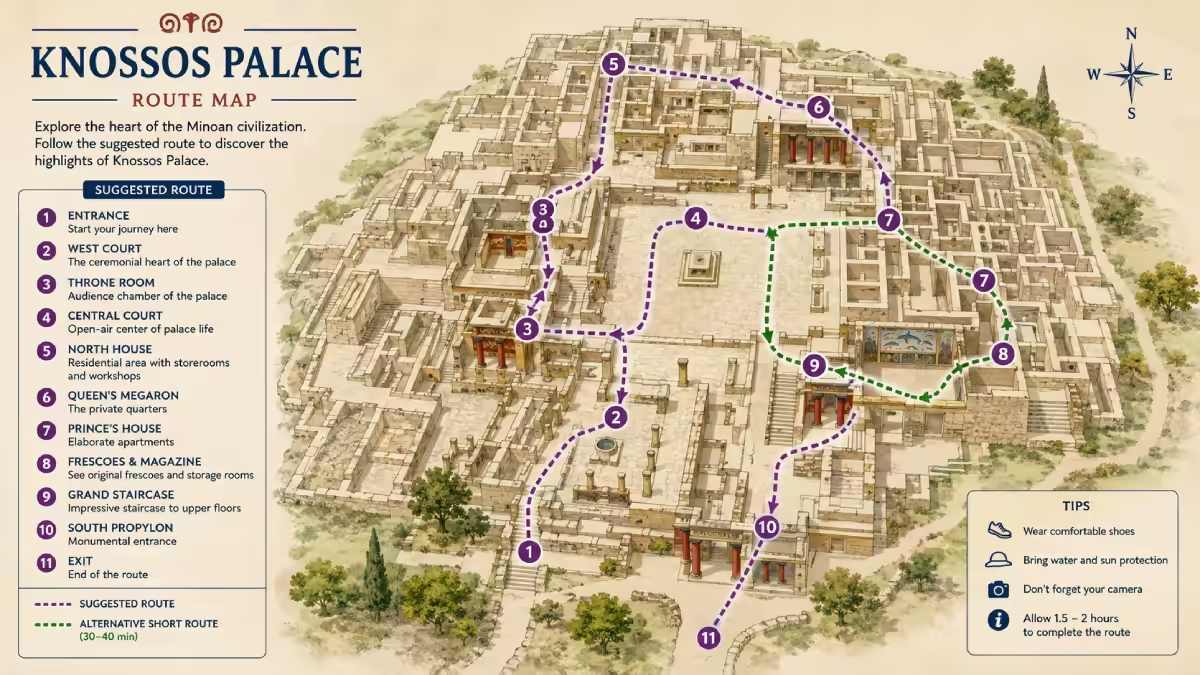
The Palace of Knossos is built around a large rectangular Central Court, with the West Wing (Throne Room and storerooms) on one side and the East Wing (Grand Staircase and Queen’s Megaron) on the other, entered from the West Court or the North Entrance. Because signage is limited, it pays to know the layout in advance. A comfortable loop takes about 1.5 to 2 hours.
At first glance the Palace of Knossos can look like a bewildering maze of walls, ramps and reconstructed columns — fitting for the site tied to the legend of the Labyrinth. In reality the layout is logical once you grasp its organizing idea: everything radiates from a single large Central Court, with wings of rooms around it and two main ways in. Understanding that plan before you arrive turns a confusing sprawl into a readable ancient city.
This guide walks through how the palace is organized — the West Court and theatral area, the West Wing, the piano nobile, the East Wing and the North Entrance — and finishes with a suggested route through the highlights.
Knossos Layout at a Glance
| Area | What you’ll find |
|---|---|
| West Court & theatral area | Paved entry court, raised “theater” steps, processional way |
| West Wing | Throne Room, ritual rooms, long storerooms with giant pithoi |
| Piano nobile | Reconstructed upper floor above the West Wing |
| Central Court | Ceremonial heart of the palace, linked to bull-leaping |
| East Wing | Grand Staircase, Queen’s Megaron, residential quarter |
| North Entrance | Sloping corridor with the charging-bull relief |
The Central Court: The Heart of the Palace
The Central Court is a large paved rectangle at the middle of Knossos, roughly 50 by 25 meters, and every wing of the palace opens onto it. It was the ceremonial focus of Minoan life and is often linked to bull-leaping rituals. Orient yourself here first: the Throne Room lies on its western side, the residential quarter to the east.
Start by fixing the Central Court in your mind, because it anchors everything else. This open paved rectangle sat at the core of the complex, with the surrounding administrative, religious, residential and storage rooms arranged around it like a small city around a plaza. If you feel lost among the reconstructed walls, head back to this open space and reorient: west side means Throne Room and storerooms, east side means the staircase and living quarters.
West Court, Theatral Area & the Approach
Most visitors enter from the West Court, a broad paved plaza crossed by raised stone walkways once used for processions. To one side lies the theatral area, a set of shallow stepped platforms sometimes called the oldest theater in Europe, thought to have hosted ceremonies. This western approach is also where the ticket booth and main gate sit, so it is where your visit begins in practice as well as historically.
The West Wing: Throne Room & Storerooms
The West Wing holds the palace’s most famous room, the Throne Room, with its gypsum throne and griffin frescoes, alongside ritual spaces and a long row of narrow storerooms where giant clay pithoi held oil, grain and wine. It sits along the western edge of the Central Court and is usually the busiest part of the site.
The Throne Room is the highlight of the West Wing: a small chamber with a carved gypsum seat flanked by painted griffins, often called the oldest throne in Europe. Behind and beside it run the long, narrow magazines — storerooms lined with rows of massive storage jars, or pithoi, that reveal how much surplus the palace controlled. The wall paintings here are replicas; the originals are in the Heraklion Archaeological Museum. Above the West Wing, Arthur Evans reconstructed an upper floor he called the piano nobile, a raised level he believed held reception and ceremonial halls.
The East Wing: Grand Staircase & Queen’s Megaron
The East Wing, cut into the slope on the far side of the Central Court, contains the residential quarter reached by the multi-story Grand Staircase and includes the Queen’s Megaron with its dolphin fresco and remarkably advanced drainage. This is the most vertical part of the site, so wear sure footing for the steps.
Cross the Central Court to reach the East Wing, built down the hillside so it once rose several stories. The Grand Staircase descends through a light-well that shows off Minoan engineering and leads into the residential quarter. Here you will find the Queen’s Megaron, with its dolphin fresco and sophisticated plumbing, including drainage channels and an early flushing toilet. Because this wing is stepped and uneven, it is where footwear matters most; our guide on what to wear and bring covers the essentials.
The North Entrance & Charging Bull
The North Entrance is the palace’s other main gateway, a sloping corridor that ran down toward the port road and is guarded by a reconstructed relief of a charging bull — one of the site’s signature images. The charging-bull fresco sits above the western bastion of this passage and is a natural photo stop. From the North Entrance you can loop back toward the Central Court to close your circuit, or exit if you entered from this side.
A Suggested Route Through Knossos
A logical loop starts at the West Court and theatral area, moves into the West Wing for the Throne Room and storerooms, crosses the Central Court, drops into the East Wing for the Grand Staircase and Queen’s Megaron, then finishes at the North Entrance and its charging bull. This covers the highlights in about 1.5 to 2 hours with minimal backtracking.
Enter through the West Court, pause at the theatral area, then follow the processional way into the West Wing for the Throne Room and storerooms. Step onto the Central Court to get your bearings, cross to the East Wing for the Grand Staircase and residential quarter, and finish at the North Entrance and its charging-bull relief. Whether you view the reconstruction critically or simply enjoy the spectacle, our guide to Arthur Evans’s reconstruction explains what is ancient and what he rebuilt, and our guide on how long to spend helps you match the route to your day.
Frequently Asked Questions
How is the Palace of Knossos laid out?
Knossos is arranged around a large central paved courtyard, with wings of rooms on each side. The West Wing holds the Throne Room and storerooms, the East Wing holds the residential quarter with the Grand Staircase and Queen’s Megaron, and there are main entrances from the West Court and the North Entrance. Fixing the Central Court in your mind is the key to navigating the rest.
Where is the Throne Room?
The Throne Room sits on the western side of the Central Court, in the West Wing. It is a small chamber with a carved gypsum throne flanked by griffin frescoes and is often the busiest spot on site. If you enter from the West Court, it is one of the first major highlights you reach, so arriving early helps you see it before the coach groups arrive.
Is there an official map at the site?
On-site signage and mapping are limited, which is why knowing the layout in advance helps so much. Some visitors buy a plan or booklet, but many rely on a guide or audio guide to navigate the rooms. Downloading a site map to your phone before you go is a smart, free alternative, since coverage at the gate can be patchy.
How long does it take to walk the whole palace?
Allow about 1.5 to 2 hours to follow a sensible loop through the West Wing, Central Court, East Wing and North Entrance at a comfortable pace. Add time if you use a full audio guide, pause often for photos, or need shade breaks in peak heat. The palace is compact, but the uneven paths and steps slow you down.
What is the Central Court?
The Central Court is the large paved rectangle at the middle of the palace, around 50 by 25 meters, onto which every wing opened. It was the ceremonial and social heart of Knossos and is commonly associated with bull-leaping rituals depicted in Minoan art. Practically, it is also the best place to reorient yourself if the surrounding walls start to feel like a maze.
What is the difference between the West Wing and East Wing?
The West Wing, on the western side of the Central Court, was largely ceremonial and administrative, holding the Throne Room, ritual rooms and long storerooms of pithoi. The East Wing, built down the slope opposite, was residential, reached by the Grand Staircase and including the Queen’s Megaron. The East Wing is the more vertical, stepped part of the site.
Where is the charging bull at Knossos?
The charging-bull relief sits above the North Entrance, the sloping corridor at the northern edge of the palace that once led toward the harbor road. It is a reconstructed fresco relief and a popular photo stop. On a standard loop it makes a natural final highlight before you head back toward the Central Court or exit.
Do I need a guide to navigate Knossos?
You can navigate on your own if you study the layout beforehand, but many visitors find a guide or audio guide invaluable, since signage is sparse and the reconstructed walls carry little explanation. A guide also points out details you would otherwise miss. To self-navigate, plan your route around the Central Court and keep this layout in mind.
When is the best time to walk the site?
Right at opening. The palace is open-air with almost no shade, so an early start means cooler air and fewer crowds along the narrow storerooms and the Grand Staircase, where groups bunch up. Our guide to the best time to visit breaks down the quietest windows by season so you can walk the route in comfort.
