
Knossos History Timeline: From the Neolithic to Today
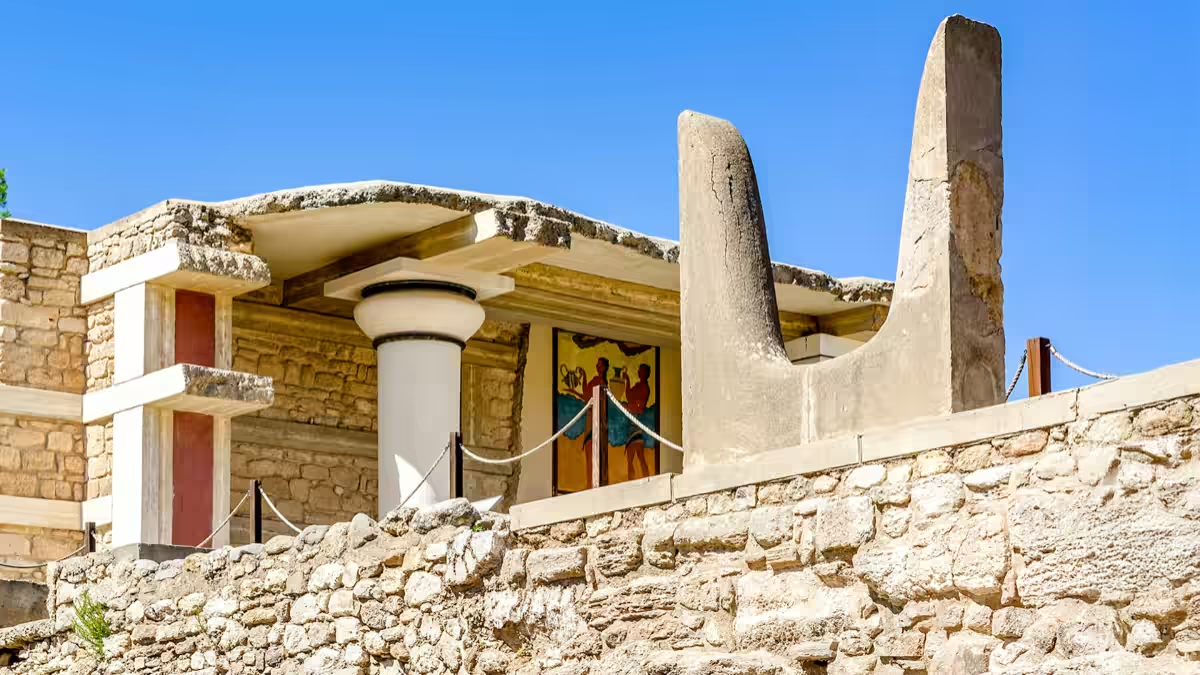
Knossos began as a Neolithic settlement before 7000 BC. The first Minoan palace rose around 1900 BC, was destroyed and rebuilt, and reached its peak before declining around 1450–1350 BC, after which Mycenaean Greeks controlled it. The site was later abandoned, rediscovered in 1878, and famously excavated and reconstructed by Sir Arthur Evans from 1900. It is now Crete’s most visited monument.
Knossos is often summed up as “4,000 years old,” but its story runs far deeper and stranger than a single date. The same low hill was lived on for thousands of years, rebuilt after disasters, taken over by newcomers, forgotten, and finally dug back into daylight in modern times. Understanding that sequence makes the ruins far easier to read on the ground.
This guide lays out the history of Knossos as a clear chronological timeline, from the first Neolithic farmers to the excavated site you visit now. Dates before the modern era are approximate — the Bronze Age has no written calendar we can pin exactly — so treat them as scholarly estimates rather than fixed years.
Knossos Timeline at a Glance
| Period | Approximate date | What happened |
|---|---|---|
| Neolithic settlement | before 7000 BC | Farmers settle the hill of Kephala |
| First (“Old”) Palace | around 1900 BC | The first great palace is built |
| Rebuild (“New” Palace) | around 1700 BC | Palace destroyed and rebuilt grander |
| Minoan peak | 1700–1450 BC | Height of wealth, art and trade |
| Decline & Mycenaean control | 1450–1350 BC | Destruction; Greek-speaking rulers take over |
| Abandonment | after 1350 BC | Palace falls out of use over time |
| Rediscovery | 1878 | Minos Kalokairinos digs the first trenches |
| Evans’s excavation | from 1900 | Large-scale digging and reconstruction |
| Today | current | Crete’s most visited archaeological site |
Neolithic Beginnings
Before Knossos was a palace it was one of Europe’s earliest villages. People settled the low hill of Kephala well before 7000 BC, farming and building simple houses. Over thousands of years the debris of these settlements built up into a mound, and it was on top of this deep Neolithic layer that the first Minoan palace was later raised.
The story starts with farmers, not kings. Excavations found a thick Neolithic deposit beneath the palace, evidence that people lived, cooked and buried their dead on this hill for several millennia before any grand architecture appeared. That makes Knossos one of the oldest continuously occupied sites in Europe.
These early villagers left pottery, tools and post-holes rather than monuments, but their long presence explains why the later palace sits on such a high, artificial mound. The location clearly mattered — fresh water, fertile land and a route inland from the coast — long before the Minoans turned it into something spectacular.
The First Palaces, around 1900 BC
Around 1900 BC the character of the site changed dramatically. The first large palace, the “Old Palace” in archaeological terms, was built with storerooms, workshops and a central court — the template for Minoan palace life. This is the moment the Minoans, whose wider society is explained in our guide to who the Minoans were, emerge as Europe’s first advanced civilization.
Similar palaces appeared at Phaistos, Malia and elsewhere on Crete at roughly the same time, suggesting a shared culture organized around these centers. The palaces were hubs for administration, storage, craft and religion. Knossos, the largest, likely held a leading position among them, though how much political control it exercised over the others remains debated.
Destruction, Rebuilding and the Peak
Bronze Age Crete was seismically active, and the palaces were damaged repeatedly. Around 1700 BC the first palace at Knossos was destroyed — probably by earthquake — and rebuilt on an even grander scale as the “New Palace.” This rebuilt version, with its multiple stories, light-wells and celebrated Throne Room, is essentially the layout visitors trace today.
The period from around 1700 to 1450 BC was the Minoan high point: peak wealth, the finest frescoes, wide sea trade and the height of palace administration. It is also the era that gave rise to the legends later attached to the site — the world of King Minos behind the myth of the Minotaur and the Labyrinth. For a couple of centuries, Knossos was as sophisticated as anywhere in Europe.
Decline and Mycenaean Control, 1450–1350 BC
Around 1450 BC many Minoan sites suffered destruction, possibly linked to the massive eruption of Thera (Santorini) and its aftermath, and to the arrival of Mycenaean Greeks from the mainland. Knossos alone continued for a while under Mycenaean control, shown by the Greek-language Linear B tablets, before it too declined toward 1350 BC.
The Minoan world unraveled in the Late Bronze Age. A wave of destructions struck Cretan sites around 1450 BC, and scholars still debate the causes: the earlier eruption of Thera and its tsunamis and ash, internal upheaval, and the growing power of the Mycenaeans have all been proposed. It was likely a combination rather than one catastrophe.
Knossos is a special case. It survived the initial collapse and carried on, but now under Mycenaean Greek administration — the clearest proof being the Linear B tablets found here, which record early Greek. Over the following century the palace’s importance faded, and by around 1350 BC its era as a great center was effectively over.
Abandonment and Later Antiquity
After the palace fell out of use, life on the hill did not simply stop. People continued to live in the area, and in later antiquity a Greek and then Roman town of Knossos existed nearby, quite separate from the ruined Bronze Age palace. The palace itself, however, was gradually buried and forgotten as a functioning building.
For centuries the great Minoan complex survived mainly as a name in Greek myth and a few classical references, its physical remains hidden under earth and later structures. The gap between the living palace and its rediscovery spans well over three thousand years — one reason the modern excavation felt like uncovering a lost world rather than restoring a known one.
Rediscovery and Arthur Evans, from 1900
The modern chapter opens in 1878, when the Cretan merchant and antiquarian Minos Kalokairinos dug the first trenches and struck parts of the palace, including storerooms with giant jars. His work signaled that something major lay beneath the mound, but full excavation had to wait for Crete’s changing political situation.
That moment came in 1900, when Sir Arthur Evans began large-scale excavation and, controversially, reconstruction. Evans coined the term “Minoan,” uncovered the palace’s plan, and rebuilt sections in reinforced concrete to protect and interpret them. His methods still divide opinion, a debate covered fully in our guide to Arthur Evans and the reconstruction controversy. What you walk through owes as much to Evans as to the Minoans.
Knossos Today
Knossos is now the most visited archaeological site on Crete, drawing large crowds year-round to a compact, open-air ruin about 5 km south of Heraklion. Much of what stands is Evans’s early-1900s reconstruction, and the vivid frescoes on site are reproductions, with the originals displayed in the Heraklion Archaeological Museum in the city.
Managed by the Greek Ministry of Culture, the site continues to be studied, conserved and debated, and it has featured on tentative lists for UNESCO World Heritage status. For today’s visitor it offers a rare chance to walk a 4,000-year-old palace whose timeline runs from Neolithic farmers to modern archaeology in a single hillside.
Frequently Asked Questions
How old is Knossos?
The palace of Knossos is roughly 4,000 years old, with the first great palace built around 1900 BC. But the hill was settled far earlier, in the Neolithic period before 7000 BC, making it one of the oldest inhabited sites in Europe. So depending on what you count, Knossos is either about four thousand or nearly nine thousand years old.
When was the palace of Knossos built?
The first (“Old”) palace was built around 1900 BC. After destruction around 1700 BC, it was rebuilt on a grander scale as the “New” palace, and this rebuilt version — with its Throne Room, staircases and light-wells — is essentially the layout you see today. All Bronze Age dates are approximate estimates rather than exact years.
Why did the Minoan civilization decline?
Minoan decline in the Late Bronze Age, around 1450–1350 BC, had several likely causes rather than one. Scholars point to the massive eruption of Thera (Santorini) and its aftermath, possible earthquakes and internal upheaval, and the rising power of Mycenaean Greeks who took control of Knossos. Most experts see it as a combination of natural disaster and outside pressure.
What happened to Knossos after the Minoans?
Knossos continued under Mycenaean Greek control for a time after around 1450 BC, evidenced by Linear B tablets, before declining by roughly 1350 BC. The palace was eventually abandoned and buried, though a separate Greek and later Roman town of Knossos existed nearby in classical antiquity. The Bronze Age palace itself stayed lost until the modern era.
When was Knossos discovered?
The site was first investigated in 1878 by the Cretan antiquarian Minos Kalokairinos, who dug trial trenches and found parts of the palace. Full-scale excavation began in 1900 under Sir Arthur Evans, who uncovered the palace plan, named the “Minoan” civilization, and reconstructed large sections in concrete over the following decades.
Who excavated Knossos?
Sir Arthur Evans, a British archaeologist, led the major excavation from 1900. He revealed the palace’s layout, coined the term “Minoan,” and controversially rebuilt parts of the structure in reinforced concrete. Earlier, Minos Kalokairinos had opened the first trenches in 1878. Evans’s decades of work, and his reconstructions, shape almost everything a visitor sees today.
Was Knossos destroyed by a volcano?
Not directly, but the eruption of Thera (Santorini), one of the largest in human history, is often linked to Minoan decline. Its ash falls, tsunamis and disruption to trade and agriculture may have weakened Minoan society, making it vulnerable to later destructions and Mycenaean takeover. The eruption is one factor among several, and the exact chain of events is still debated.
Is Knossos a UNESCO World Heritage Site?
Knossos is Crete’s most visited archaeological monument and has appeared on tentative lists for UNESCO World Heritage status, but it is best confirmed directly through official heritage sources for the current designation. Whatever its formal status, it is protected and managed by the Greek Ministry of Culture as one of the country’s most important ancient sites.
