
Knossos vs Pompeii, the Acropolis & Ephesus Compared
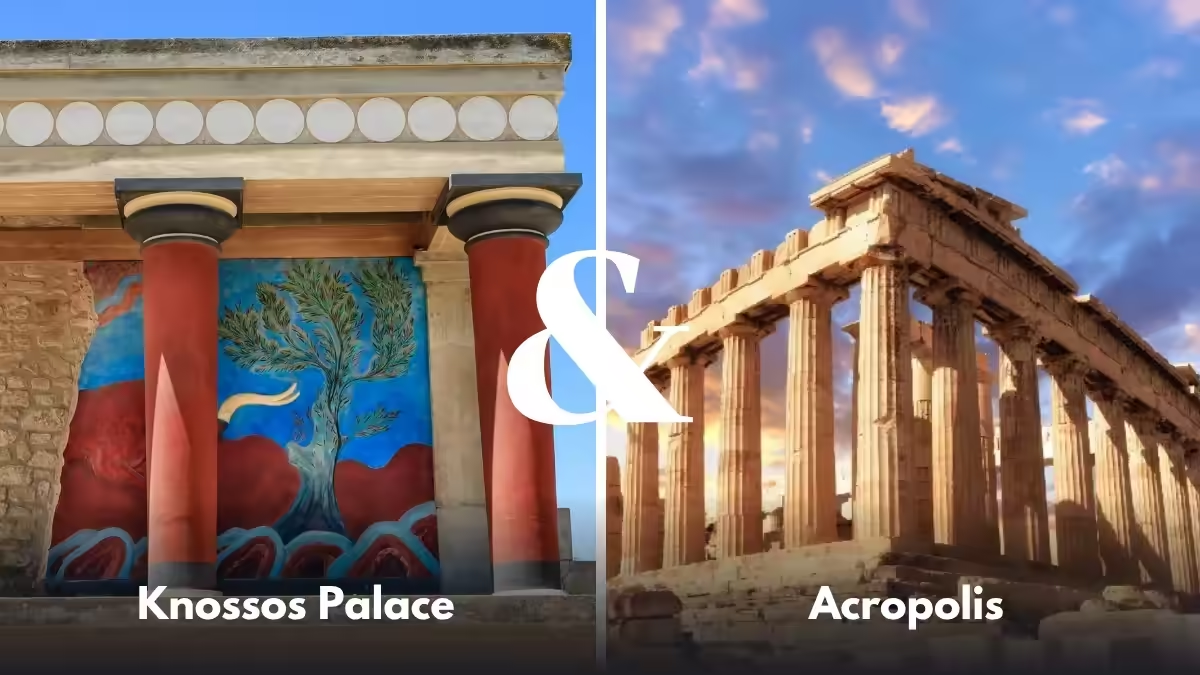
Knossos and Pompeii are both ancient, but they’re worlds apart. Knossos is a Bronze Age Minoan palace roughly 4,000 years old — far older than Pompeii, the Roman town frozen by Vesuvius in 79 AD. Knossos was heavily reconstructed in concrete by Arthur Evans, while Pompeii survives largely as it fell. Each rewards a different kind of traveler.
Travelers often ask how Knossos stacks up against Pompeii, the Acropolis in Athens, or Ephesus in Turkey. It’s a fair question, because these are very different experiences despite all being called “ancient.” The gap in age alone is startling: Knossos predates Pompeii by around two thousand years.
This guide compares Knossos honestly with the other great Mediterranean sites — the reconstruction question included — and helps you decide which suits your interests and your itinerary.
How the Sites Compare at a Glance
| Site | Era | State of preservation | Best known for |
|---|---|---|---|
| Knossos (Crete) | Bronze Age, ~1900 BC | Ruins reconstructed by Evans | Minoan palace, Minotaur myth |
| Pompeii (Italy) | Roman, 79 AD | Preserved as it fell | Everyday Roman town frozen in time |
| Acropolis (Athens) | Classical, 5th c. BC | Original ruins, partly restored | The Parthenon, Greek democracy |
| Ephesus (Turkey) | Greek & Roman | Extensive standing ruins | Library of Celsus, grand streets |
Ages are approximate; each site spans multiple building phases. The point is the sheer spread — from Knossos in the Bronze Age to Pompeii’s Roman heyday.
Knossos vs Pompeii: The Key Difference
Knossos is roughly 4,000 years old, a Bronze Age Minoan palace, while Pompeii is a Roman town destroyed in 79 AD — about two millennia younger. The bigger contrast is how you experience them: Knossos was rebuilt in concrete by Arthur Evans to suggest how it looked, whereas Pompeii survives almost untouched, buried and preserved by volcanic ash.
The headline difference is age. Knossos flourished in the Bronze Age, around 1900 BC, when the Minoans were Europe’s first advanced civilization. Pompeii belongs to the Roman era and met its end in 79 AD when Vesuvius erupted. That’s a gap of nearly two thousand years — Knossos was already an ancient ruin long before Pompeii existed.
The second difference is authenticity of the standing structures. Pompeii was preserved almost as a snapshot: streets, houses, shops and even casts of victims survive because ash sealed the town. Knossos is the opposite — much of what you walk through is Sir Arthur Evans’s early-1900s reconstruction in reinforced concrete, painted to evoke the original. Our guide to Arthur Evans’s reconstruction explains why that remains controversial, and why the on-site frescoes are replicas rather than originals.
Knossos vs the Acropolis and Ephesus
The Acropolis in Athens is Classical Greek, dominated by the fifth-century-BC Parthenon. Its ruins are largely original stone, carefully consolidated rather than rebuilt, so you’re looking at genuine ancient marble. It’s grander in scale and instantly iconic, but it’s a temple complex rather than a lived-in palace.
Ephesus, in Turkey, offers extensive standing ruins of a Greek and Roman city — the Library of Celsus, marble streets and a vast theater — giving a strong sense of urban life. Compared with both, Knossos is older, smaller and more intimate, and the appeal is different: it’s the deep antiquity, the Minoan story and the legendary Labyrinth of the Minotaur that set it apart, not sheer monumental scale.
What Makes Knossos Distinct
Knossos stands out for its age and story rather than its scale. It’s the largest Minoan palace and among the oldest major sites in Europe, the home of Europe’s first advanced civilization, and the mythical Labyrinth of King Minos. Its reconstructed rooms, advanced Bronze Age plumbing and vivid replica frescoes offer a vision of Minoan life you won’t find anywhere else.
Where Pompeii shows Roman daily life and the Acropolis shows Classical power, Knossos shows something older and stranger: a Bronze Age palace with light-wells, multi-story residential quarters, an early drainage system and one of the oldest thrones in Europe. Add the myth of the Minotaur and the origins of the Minoan civilization, and Knossos occupies a niche none of the others do. To place it on the wider timeline, our history timeline guide traces it from Neolithic settlement to Minoan collapse.
Which Site Suits Which Traveler
If you want an intact ancient town you can wander for hours, Pompeii wins. If you want iconic Classical architecture and marble on a grand scale, the Acropolis or Ephesus deliver. If you’re drawn to deep antiquity, myth and the earliest chapter of European civilization — and you’re comfortable that much is a reconstruction — Knossos is unmatched, and a compact 1.5-to-2-hour visit. Our guide on whether Knossos is worth visiting helps you decide, and a guided walking tour makes the ruins far easier to read.
Frequently Asked Questions
Is Knossos older than Pompeii?
Yes, by a long way. Knossos is a Bronze Age Minoan palace with main structures dating from around 1900 BC, roughly 4,000 years old. Pompeii is a Roman town destroyed by Vesuvius in 79 AD, making it about two thousand years younger. Knossos was already an ancient, long-abandoned site by the time Pompeii was a thriving Roman town.
How is Knossos different from Pompeii?
Beyond age, the biggest difference is how they survive. Pompeii was preserved almost intact under volcanic ash, so you walk real Roman streets and buildings. Knossos was largely reconstructed in concrete by Arthur Evans from 1900 to suggest how the palace once looked. One is a genuine snapshot; the other is an interpretive rebuild of a much older, more fragmentary ruin.
Is Knossos or the Acropolis more impressive?
It depends on what impresses you. The Acropolis is grander and more monumental, crowned by the original marble Parthenon, and it’s Classical Greek rather than Bronze Age. Knossos is smaller, older and more atmospheric, with reconstructed rooms and the pull of the Minotaur myth. For sheer scale, the Acropolis; for deep antiquity and story, Knossos.
How does Knossos compare to Ephesus?
Ephesus offers far more standing ruins — grand streets, the Library of Celsus and a huge theater — and a vivid sense of a Greek and Roman city. Knossos is older, more compact and centered on a single Minoan palace rather than a whole city. If you want scale and urban sweep, Ephesus; if you want Bronze Age origins and myth, Knossos.
Is Knossos worth visiting if I’ve seen other ancient sites?
Yes, precisely because it’s unlike the others. Knossos is far older than Pompeii, the Acropolis or Ephesus and tells the Minoan story rather than a Roman or Classical Greek one. The reconstruction divides opinion, but nothing else offers the same window into Europe’s first advanced civilization. Pairing it with the Heraklion museum, which holds the original frescoes, rounds out the picture.
Why does Knossos look reconstructed?
Because it largely is. Sir Arthur Evans rebuilt walls, columns and upper floors in reinforced concrete from 1900, painting reproductions of the frescoes in place. Defenders say this protects the fragile ruins and helps visitors picture Minoan life; critics call much of it imaginative guesswork. Either way, it’s why Knossos feels more “rebuilt” than a site like Pompeii or the Acropolis.
Which ancient site is best for families?
Knossos travels well with children thanks to the Minotaur and Labyrinth story and its compact size, though it has uneven paths and little shade. Pompeii is larger and involves more walking; the Acropolis means a hot uphill climb. For a shorter, story-driven visit that keeps younger kids engaged, Knossos is a strong choice — bring water and sun protection whichever you pick.
Can I visit Knossos and Pompeii on the same trip?
Only with some planning, since they’re in different countries — Knossos on Crete, Pompeii near Naples in Italy. Many travelers pair Knossos instead with nearby Greek sites or the Heraklion Archaeological Museum. If you’re island-hopping or on a wider Mediterranean cruise, both can feature, but they aren’t a natural same-day or same-week combination.
What makes Knossos unique among ancient sites?
Its combination of extreme age, Minoan identity and myth. Knossos is the largest Minoan palace, among the oldest major sites in Europe, home to Bronze Age innovations like advanced drainage and light-wells, and the legendary seat of King Minos and the Labyrinth. No other Mediterranean site blends that antiquity with such a famous myth in one compact, walkable place.
