
Who Were the Minoans? Minoan Civilization Explained
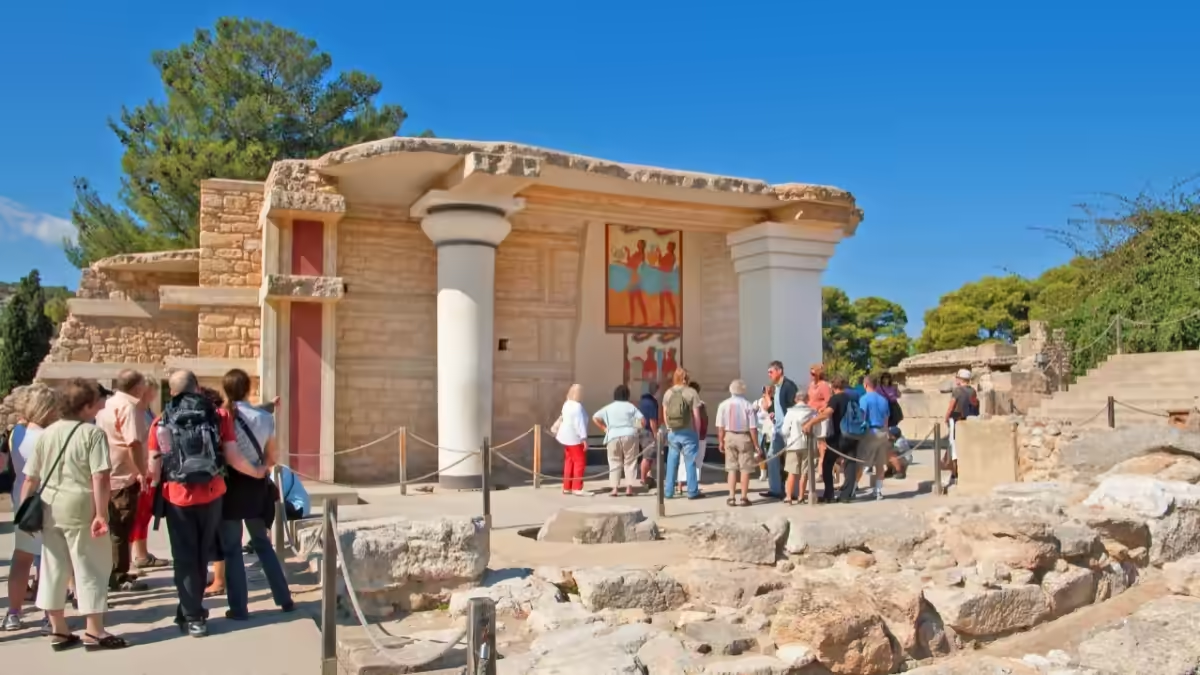
The Minoans were a Bronze Age people who lived on Crete and nearby islands, best known for the great palace at Knossos. Flourishing from around 1900 BC, they are widely called Europe’s first advanced civilization, notable for grand palaces, vivid frescoes, wide-ranging sea trade, a bull-centered religion and two writing systems, Linear A and Linear B. Arthur Evans named them “Minoan” after the legendary King Minos.
Everyone arrives at Knossos knowing the Minotaur, but far fewer know the real people who built the palace. The Minoans left no epic poems and no king list we can read, yet they raised the most sophisticated society Europe had yet seen — centuries before classical Greece or Rome. Their traces are the ruins, the art and the puzzling scripts they left behind.
This guide explains who the Minoans actually were: where and when they lived, how their society and economy worked, what their art and religion tell us, and why their two scripts still matter. It’s the factual companion to the legend, and the culture behind everything you walk through on site.
Who Were the Minoans?
The Minoans were the Bronze Age civilization of Crete, active from roughly 3000 BC and at their height around 1900–1450 BC. They built large palace complexes such as Knossos, Phaistos and Malia, traded across the eastern Mediterranean, and are often called the first advanced civilization in Europe. “Minoan” is a modern label coined by Arthur Evans; we don’t know what they called themselves.
The Minoans were centered on Crete, the large island south of mainland Greece, with a reach that extended to the Cyclades and beyond. They are named for the legendary King Minos, a name Arthur Evans applied when he began excavating Knossos in 1900 — so the term is an archaeologist’s convenience, not something the people used for themselves.
What set them apart was scale and sophistication. While much of Europe still lived in villages, the Minoans built multi-story palaces with running water, drainage, storerooms and workshops, all organized around a central court. That achievement, more than any single object, is why they hold the title of Europe’s first advanced civilization. For the full sequence of their rise and fall, see our Knossos history timeline.
Society and Daily Life
Minoan society appears to have been organized around the palaces, which functioned as administrative, economic and religious hubs rather than simply royal homes. Vast storerooms held giant clay jars, called pithoi, filled with olive oil, wine and grain — surplus that the palace collected, recorded and redistributed. This “palace economy” implies officials, scribes and a hierarchy, even if we can’t name its rulers.
Beyond the elite, farmers, potters, weavers, metalworkers and sailors kept the system running. The art gives glimpses of daily life: people in colorful clothing, women prominently depicted at ceremonies and gatherings, and a striking absence of grand battle scenes compared with other Bronze Age cultures. That has led some scholars to picture a relatively peaceful, trade-focused society, though the evidence is debated rather than settled.
Art and Architecture
Minoan art is famous for its lively, naturalistic frescoes — dolphins, bulls, lilies, processions and leaping athletes — painted in bright colors. In architecture, the Minoans pioneered multi-story palaces with light-wells, colonnades, advanced drainage and even early flushing toilets. Both the art and the engineering at Knossos are far ahead of anything else in Bronze Age Europe.
The Minoans were extraordinary decorators. Their frescoes favor movement and nature over stiff formality: fish curling through water, plants in bloom, athletes vaulting bulls. You can explore these in our guide to the Minoan frescoes, remembering that the panels on site are reproductions and the originals hang in the Heraklion Archaeological Museum.
Their engineering is just as impressive. Knossos shows off light-wells that pull sun into lower floors, sophisticated drainage, and the celebrated advanced plumbing of the Queen’s Megaron. The gypsum seat in the Throne Room is often called the oldest throne in Europe — one more sign of a culture inventing forms the rest of the continent had not yet imagined.
Trade and the Sea
The Minoans were a seafaring people, and the sea made them rich. From Crete they traded olive oil, wine, fine pottery, textiles and worked metals, exchanging them for copper, tin, gold, ivory and other raw materials. Minoan goods and artistic influence turn up in Egypt, the Levant, Cyprus and the Aegean islands, marking a genuine trading network rather than isolated contact.
This maritime reach is sometimes called a “thalassocracy,” or rule of the sea, a term the later Greek historian Thucydides linked to Minos. Whether or not they controlled the waves militarily, the Minoans clearly depended on ships and ports, and their prosperity rose and fell with trade. That outward-looking economy helps explain how a single island produced such a wealthy, cosmopolitan culture.
Religion and Belief
Minoan religion is reconstructed almost entirely from art and objects, since we can’t read their prayers. It centered heavily on nature and on the bull, whose horns appear as the “horns of consecration” and whose image dominates ceremony. Bull-leaping — athletes vaulting over a charging bull — seems to have been a ritual as much as a sport.
Female figures are prominent, including the famous “snake goddess” figurines, leading many scholars to suggest goddess worship was central. Sacred sites included peak sanctuaries on mountaintops and caves, alongside shrines within the palaces themselves. The double axe, or labrys, was a key sacred symbol, and its link to the palace feeds directly into the myth of the Minotaur and the Labyrinth.
Writing: Linear A and Linear B
The Minoans used two scripts. Linear A, their own writing, recorded the Minoan language and has never been deciphered. Linear B, a later adaptation used after Mycenaean Greeks gained influence at Knossos, was decoded in 1952 and turned out to record an early form of Greek. Both survive mainly as clay administrative tablets listing goods and quantities.
Writing is where the Minoans stay tantalizingly out of reach. Linear A, their own script, appears on tablets and objects across Crete, but because we don’t know the underlying language it remains undeciphered — we can see them keeping accounts without knowing exactly what they said. It is one of the great unsolved puzzles of the ancient world.
Linear B is a different story. Used at Knossos in the palace’s later phase, it was famously deciphered by Michael Ventris in 1952 and proved to record Greek, evidence that Mycenaeans from the mainland had taken over administration. The tablets are mostly inventories — sheep, oil, wheat, workers — but they confirm the palace economy and mark the transition from Minoan to Mycenaean control at Knossos.
Frequently Asked Questions
Where did the Minoans live?
The Minoans lived on Crete, the large island south of mainland Greece, with influence extending across the Aegean to islands such as Thera (Santorini) and contact reaching Egypt and the Levant. Their major centers were palace complexes at Knossos, Phaistos, Malia and Zakros. Knossos, about 5 km south of modern Heraklion, was the largest and most important of these palaces.
When did the Minoan civilization exist?
Minoan culture on Crete developed from around 3000 BC and reached its height roughly between 1900 and 1450 BC, the era of the great palaces. It declined in the Late Bronze Age, around 1450–1350 BC, after which Mycenaean Greeks controlled Knossos. This makes the Minoans older than classical Greece by more than a thousand years.
Why are they called Minoans?
“Minoan” is a modern name coined by the archaeologist Arthur Evans, who began excavating Knossos in 1900. He took it from the legendary King Minos, said to have ruled Crete. We don’t know what the people actually called themselves, since their own script, Linear A, has never been deciphered, so the label is a convenient invention rather than an ancient term.
Were the Minoans Greek?
Not originally. The Minoans predated the Greek-speaking Mycenaeans and spoke their own, still-undeciphered language recorded in Linear A. Only in the palace’s later phase, when Mycenaeans gained control of Knossos, does the Greek-language script Linear B appear. So early Minoans were a distinct pre-Greek people, later overlaid by Mycenaean Greek administration.
What was Minoan society like?
Minoan society was organized around palaces that acted as administrative, economic and religious centers, running a “palace economy” that collected and redistributed goods like oil, wine and grain. Art suggests colorful dress, prominent roles for women in ceremony, and relatively few depictions of warfare. Below the elite were farmers, artisans and sailors who sustained a prosperous, trade-based culture.
What did the Minoans trade?
The Minoans traded across the eastern Mediterranean, exporting olive oil, wine, fine pottery, textiles and metalwork, and importing raw materials such as copper, tin, gold and ivory. Minoan goods and artistic influence appear in Egypt, the Levant, Cyprus and the Aegean. This maritime trade, sometimes called a thalassocracy, underpinned their wealth and cosmopolitan character.
What religion did the Minoans follow?
Minoan religion, reconstructed from art, centered on nature and the bull, with the “horns of consecration” and bull-leaping as key elements. Prominent female figures, including “snake goddess” figurines, suggest goddess worship was important. Worship took place at peak sanctuaries, sacred caves and palace shrines, and the double axe, or labrys, was a central sacred symbol.
Has Minoan writing been deciphered?
Partly. Linear B, used in the palace’s later Mycenaean phase, was deciphered in 1952 and records an early form of Greek, mostly in administrative lists. Linear A, the Minoans’ own earlier script, remains undeciphered because the language behind it is unknown. So we can read the accounts of their successors but not the Minoans’ own words.
