
The Minotaur Myth & the Labyrinth of Knossos Explained
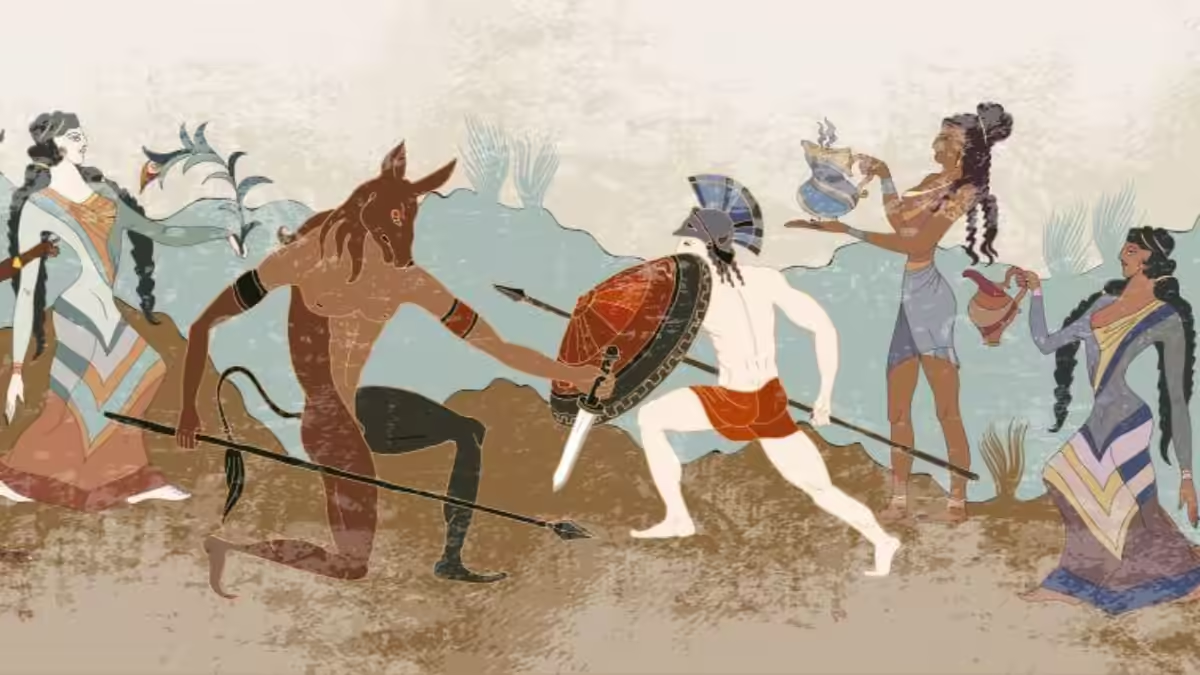
The Minotaur was a bull-headed man kept in a maze called the Labyrinth, built for King Minos of Knossos. The Athenian hero Theseus killed it and escaped using a thread given by Minos’s daughter Ariadne. The legend likely grew from the real palace: a sprawling, multi-story building of some 1,300 rooms, filled with bull imagery and the double-axe “labrys” that may have given the Labyrinth its name.
Few ruins carry a story as famous as Knossos. Long before archaeologists dug here, Greeks told of King Minos, a monstrous half-bull son, and a maze so cunning that no one who entered came out alive. Stand in the palace today and it’s easy to see why the myth stuck: the plan really is a warren of corridors, staircases and light-wells that folds back on itself.
This guide separates the legend from the stones. It walks through the myth of the Minotaur and the Labyrinth, the roles of Theseus and Ariadne, and the concrete details of the site — the bull imagery and the double axe — that most likely gave the story its shape.
The Myth in Brief
In the legend, King Minos of Knossos angered the god Poseidon, whose curse caused Minos’s wife Pasiphaë to bear the Minotaur — a creature with a bull’s head and a human body. Minos had the craftsman Daedalus build the Labyrinth to hide the beast, then fed it a regular tribute of young Athenians until the hero Theseus killed it.
The trouble begins with a broken promise. Poseidon sends Minos a magnificent white bull to sacrifice, but the king keeps it for himself. In revenge the god makes Pasiphaë, the queen, fall in love with the animal, and from that union comes the Minotaur — Greek for “bull of Minos.” Ashamed and unable to kill it, Minos orders Daedalus to design a prison so complex that the monster can never find its way out. That prison is the Labyrinth.
To feed the creature, Minos demands a grim tribute from Athens, which he has defeated in war: seven youths and seven maidens sent every few years into the maze. It is a story about power, shame and the cost of defying the gods — and it places all of it squarely inside the palace at Knossos.
Theseus, Ariadne, and the Thread
The hero of the tale is Theseus, prince of Athens, who volunteers to join the tribute and end the slaughter. When he arrives on Crete, Ariadne, one of Minos’s daughters, falls in love with him and decides to help. Her gift is deceptively simple: a ball of thread, tied at the entrance, that he can unspool as he goes and follow back out. It is the original “clue” — the word once meant a ball of yarn.
Theseus makes his way to the heart of the maze, kills the Minotaur, and traces the thread back to the door. He escapes with Ariadne, though the story turns bittersweet: he later abandons her on the island of Naxos. What matters for Knossos is the mechanics of the legend — the idea of a space so confusing that you need a trick to survive it. That single detail is what later visitors, seeing the ruins, would recognize in the stones themselves.
What Is the Labyrinth — and Was It Real?
There is no separate maze building at Knossos. Most scholars think the Labyrinth of legend was the palace itself: a huge, multi-level structure with roughly 1,300 rooms, twisting corridors, blind passages and staircases around a central court. To Bronze Age visitors and later Greeks, a building that complex would have felt genuinely maze-like.
No archaeologist has ever found a maze at Knossos, and that is the point. The palace is not a single grand hall but a dense cluster of rooms stacked on several floors, threaded by narrow passages and served by dozens of storerooms. Early visitors could easily lose their bearings, and Greeks who heard travelers’ descriptions of this vast, rambling place had a ready-made setting for a monster.
You can feel the effect for yourself as you move through the residential quarter and the Grand Staircase, where flights of steps and light-wells drop away on multiple levels. The maze-like plan wasn’t designed to trap anyone — it grew organically over centuries of rebuilding — but the impression it leaves is exactly the one the myth trades on.
The Labrys: The Double Axe Behind the Name
One of the most persuasive links between myth and site is a word. Carved and painted throughout the palace is the labrys, a double-headed axe that was a sacred Minoan symbol. Many linguists connect “Labyrinth” to labrys, reading it as something like “House of the Double Axe” — in other words, a name for the palace of Knossos itself rather than for an imaginary maze.
The double axe turns up on pillars, walls and ritual objects, marking the building as a place of ceremony and worship. If the ancients called Knossos the “place of the labrys,” it takes only a small slip of memory for a real ceremonial complex to become a legendary maze. This religious dimension belonged to a wider Minoan world you can explore in who were the Minoans, the civilization that built and used these symbols.
Bulls Everywhere: How the Myth Meets the Ruins
The Minotaur is half bull, and bulls are everywhere at Knossos. The most striking survivor is the charging-bull relief at the north entrance, a powerful painted image of the animal in full motion; you can read its story in our guide to the north entrance charging-bull fresco. Bulls also appear in the famous bull-leaping scenes, where athletes vault over the horns of a charging animal.
Scholars believe bull-leaping and bull sacrifice were central to Minoan ritual, probably staged in or around the central court at the palace’s heart. A culture this obsessed with bulls, holding dangerous ceremonies with them, is a natural seedbed for a story about a man-eating bull creature. The myth didn’t invent the bull; it exaggerated something the Minoans genuinely revered.
Where the Myth Lives at the Site Today
The frescoes and reliefs you see on site are reproductions — the surviving originals are in the Heraklion Archaeological Museum — but they still let you trace the legend in place. Note that much of what looks “ancient” is early-1900s concrete, part of the reconstruction covered in our guide to Arthur Evans and the reconstruction debate. Keeping that in mind helps you enjoy the myth without mistaking a modern reconstruction for the maze of Theseus.
If you’re deciding whether the story alone justifies the trip, our guide on whether Knossos is worth visiting weighs the experience honestly. The legend is a wonderful lens, but the real reward is walking a 4,000-year-old palace that inspired one of Europe’s oldest stories.
Frequently Asked Questions
Was the Minotaur real?
No. The Minotaur is a mythical creature — a bull-headed man — not a historical being. What is real is the palace of Knossos and the Minoan culture’s deep fascination with bulls, seen in frescoes, reliefs and the practice of bull-leaping. The myth almost certainly grew out of that real bull worship combined with the palace’s genuinely confusing, maze-like layout.
Where was the Labyrinth at Knossos?
There is no separate maze structure at the site. Most scholars believe the “Labyrinth” of legend was the palace of Knossos itself, whose roughly 1,300 rooms, twisting corridors and multiple floors would have felt bewildering to ancient visitors. The name may also come from labrys, the sacred double axe, making “Labyrinth” mean “House of the Double Axe.”
Who killed the Minotaur?
Theseus, a prince of Athens, killed the Minotaur. He volunteered to join the tribute of young Athenians sent to be devoured, then found and slew the creature at the heart of the maze. He escaped by following a thread given to him by Ariadne, King Minos’s daughter, who had fallen in love with him.
What was Ariadne’s thread?
Ariadne’s thread was a ball of yarn she gave Theseus so he could find his way out of the Labyrinth. He tied one end at the entrance and unspooled it as he went, then followed it back after killing the Minotaur. The English word “clue,” which once meant a ball of thread, comes from this story.
What does “labrys” mean and why does it matter?
Labrys is the Minoan double-headed axe, a sacred symbol carved and painted throughout Knossos. Many linguists link it to the word “Labyrinth,” reading the name as “House of the Double Axe” — a title for the palace itself. If so, the Labyrinth was never a maze but the ceremonial home of the labrys, a real place transformed by memory into legend.
Why is Knossos linked to bulls?
Bulls were central to Minoan religion and ceremony. The palace displays bull imagery in the charging-bull relief at the north entrance and in bull-leaping frescoes, where athletes vaulted over live bulls. This intense bull symbolism helped inspire the Minotaur legend, since a culture that ritualized dangerous bulls provided the raw material for a story about a monstrous bull-man.
Did King Minos really exist?
We don’t know. “Minos” may have been a personal name, a dynastic title for Cretan rulers, or a legendary figure. Arthur Evans named the whole civilization “Minoan” after him. A powerful king ruling from a palace like Knossos is entirely plausible for the Bronze Age, but there is no direct evidence tying the ruins to any specific individual named Minos.
Can I still see the myth at the palace today?
Yes, through its imagery and layout. You can view reproductions of the bull-leaping and charging-bull scenes, walk the maze-like residential quarter, and spot the double-axe symbol. Remember the frescoes on site are replicas, with originals in the Heraklion Archaeological Museum, and that much of the structure is early-1900s reconstruction rather than original Minoan masonry.
