
Sir Arthur Evans & the Knossos Reconstruction Debate
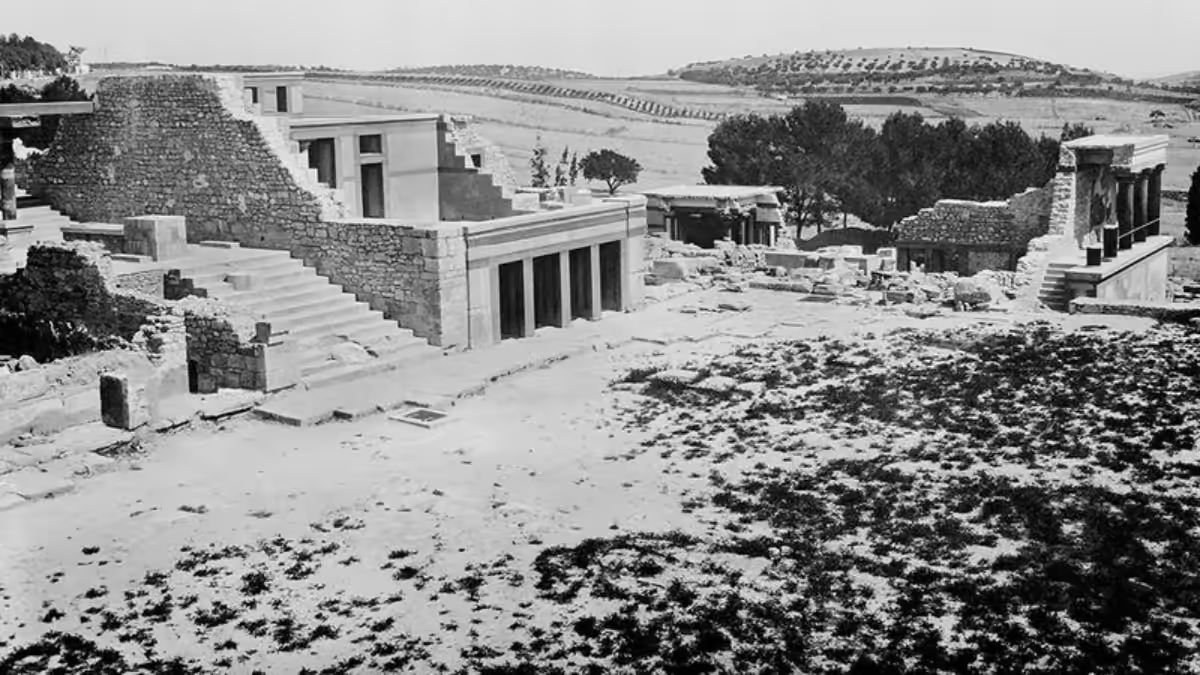
Sir Arthur Evans, a British archaeologist, excavated Knossos from 1900 and rebuilt large parts in reinforced concrete — his “reconstitutions” — complete with restored frescoes painted by the Gilliéron artists. Critics argue he imposed his own vision and invented details; defenders say the concrete protects fragile ruins and helps visitors understand them. Either way, much of what you see today is Evans’s early-1900s work, not original Minoan masonry.
Most visitors assume the colorful columns and upper floors at Knossos are ancient. They aren’t — or at least, not entirely. What you walk through is the result of one man’s decades-long project to dig up a Bronze Age palace and, just as deliberately, to rebuild it. That project made Knossos world-famous and, in the same stroke, made it one of archaeology’s most contested sites.
This guide explains who Arthur Evans was, what he actually did to the ruins, and why the reconstruction still divides experts. Knowing the debate changes how you read the site: it lets you enjoy the spectacle while telling apart the Minoan original from the modern reconstruction on top of it.
Who Was Sir Arthur Evans?
Sir Arthur Evans (1851–1941) was a wealthy British archaeologist who bought the Knossos site and began excavating it in 1900. He uncovered the Minoan palace, coined the term “Minoan” after King Minos, and spent decades and much of his own fortune digging and reconstructing it. His work made Knossos famous but remains controversial for how heavily he rebuilt the ruins.
Evans came to Knossos with means, ambition and a theory. A former newspaper correspondent and museum keeper from a well-off English family, he was convinced that Crete held an advanced pre-Greek civilization, and he was willing to spend his own money to prove it. Buying the land let him excavate on a scale few others could match.
He was proved spectacularly right: beneath the mound lay a vast palace and a previously unknown culture, which he named “Minoan,” the civilization explored in our guide to who the Minoans were. But Evans was not a neutral recorder. He had a strong picture in his mind of what Minoan Crete should look like, and he set about rebuilding the ruins to match it.
The Reconstruction: Concrete “Reconstitutions”
Evans called his rebuilding work “reconstitution,” and he leaned heavily on a then-novel material: reinforced concrete. Where the Minoans had used timber columns and framing, long since rotted away, Evans poured concrete replacements, painted them in Minoan reds and blacks, and even rebuilt entire upper stories that no longer survived — the so-called “piano nobile.”
His reasoning was partly practical. Excavation exposed fragile gypsum, mud brick and plaster to the weather, and unsupported walls and floors risked collapse; concrete could hold them up and shelter what lay beneath. You can see the approach clearly at the Grand Staircase, where reconstructed flights and columns let you grasp the multi-story design in a way bare foundations never could.
The difficulty is that reconstitution shades into invention. Rebuilding a column is one thing; rebuilding a whole floor whose layout is uncertain is another. Once concrete is poured and painted, a visitor cannot easily tell a documented detail from an educated guess — and that blurring is the heart of the controversy.
The Gilliérons and the Frescoes
The vivid frescoes at Knossos were heavily restored by two Swiss artists, Émile Gilliéron and his son, who worked for Evans. Many surviving fragments were small, so the artists filled large gaps with reconstructed scenes based on interpretation. As a result, famous images like the bull-leaping and “Prince of the Lilies” panels are part ancient, part modern painting.
The frescoes are the most beloved and most debated part of the site. In reality, much of what was excavated survived only as scattered fragments — a hand here, a patch of color there. To turn these into displayable images, Evans employed the Gilliérons, father and son, skilled artists who reconstructed whole scenes around the surviving pieces.
Their restorations are beautiful and hugely influential, but they involved real interpretive choices about poses, colors and subjects. The celebrated “Prince of the Lilies,” for instance, is assembled from fragments that may not even belong to the same figure. Our guide to the Minoan frescoes explains which parts are ancient and which are restoration — and remember the panels on site are reproductions, with the restored originals in the Heraklion Archaeological Museum.
The Case Against Evans
Critics have long argued that Evans crossed the line from archaeologist to author. By pouring permanent concrete, he made his interpretations irreversible: future scholars can’t undo the reconstruction to test other readings of the evidence. That violates a core modern principle that restoration should be reversible and clearly distinguishable from the original.
There is also the charge of projection. Evans, they argue, read his own early-1900s sensibilities into the Minoans — imagining an idyllic, peace-loving, art-obsessed society — and built ruins that flattered that image. The bright colors, the “throne of Minos” in the Throne Room, even some room names owe as much to Evans’s imagination as to hard evidence. The worry is that millions of visitors now “know” a Minoan palace that is partly a modern creation.
The Case for Evans
The defense is more sympathetic than it first appears. Evans worked before modern conservation standards existed, and the fragile materials he uncovered were genuinely disintegrating. Without intervention, much of what he found might have been lost to rain, frost and gravity within a few seasons; the concrete, for all its faults, has kept the site standing for over a century.
Defenders also point out that reconstruction serves the visitor. Bare foundations are almost unreadable to non-specialists, whereas Evans’s rebuilt columns, floors and painted scenes let ordinary people picture a living palace. For a site with limited signage, that legibility has real value — a point our guide on whether Knossos is worth visiting weighs when setting expectations. Evans made Minoan civilization visible to the world, even if he got some details wrong.
How It Shapes What You See
The practical takeaway is to visit with your eyes open. As you walk, learn to spot the tells: smooth, uniform surfaces, sharp edges and consistent red-and-black paint usually mark Evans’s concrete, while pitted, irregular gypsum and worn stone are more likely original. The upper floors and many columns are reconstruction; the storerooms, basements and worn thresholds are largely genuine.
None of this should spoil the visit — if anything, it deepens it. You are looking at two layered achievements: a Bronze Age palace and an audacious early-1900s attempt to bring it back. Treat the frescoes as reproductions of restorations, treat the concrete as informed interpretation, and Knossos becomes a richer, more honest experience than the postcard version suggests.
Frequently Asked Questions
Did Arthur Evans rebuild Knossos?
Yes, extensively. From 1900, Evans not only excavated Knossos but rebuilt large parts of it in reinforced concrete, a process he called “reconstitution.” He restored columns, walls and entire upper floors, and had the frescoes reconstructed. Much of what visitors see today, including the colorful columns and upper stories, is Evans’s early-1900s work rather than surviving Minoan structure.
Why is the Knossos reconstruction controversial?
It is controversial because Evans used permanent concrete to rebuild uncertain features, making his interpretations irreversible and hard to distinguish from the original. Critics say he projected his own idealized vision onto the Minoans and effectively invented parts of the palace. Defenders argue the work protected fragile ruins and helps visitors understand a site that would otherwise be almost unreadable.
Are the columns at Knossos original?
No. The distinctive downward-tapering columns you see are modern reconstructions in concrete, painted in Minoan-style red and black. The original timber columns rotted away thousands of years ago, leaving only their bases and impressions. Evans rebuilt them to show the palace’s appearance, so they reflect his interpretation of Minoan architecture rather than surviving ancient material.
Who painted the Knossos frescoes?
The frescoes were reconstructed by two Swiss artists, Émile Gilliéron and his son, working for Arthur Evans. Because many original fragments were small and incomplete, the Gilliérons filled large gaps with painted reconstructions based on interpretation. The famous scenes are therefore part ancient fragment, part modern painting, and the versions on site today are reproductions of these restored works.
How much of Knossos is real versus reconstructed?
A significant amount is reconstruction. Lower levels, storerooms, basements, worn thresholds and foundations are largely original Minoan work, while many walls, columns, upper floors and the painted frescoes are Evans’s early-1900s reconstruction. As a rule, smooth concrete surfaces and bright uniform paint indicate modern work, while pitted gypsum and worn stone are more likely to be genuine.
Was Arthur Evans right about the Minoans?
Partly. Evans correctly identified a major, previously unknown Bronze Age civilization and named it “Minoan,” a genuine and lasting contribution. However, some of his specific interpretations — an entirely peaceful, matriarchal, idyllic society, and certain room functions and fresco subjects — are questioned or rejected by later scholars. His big picture was groundbreaking; several of the details were his own assumptions.
Should the reconstruction change how I visit?
It helps to know in advance. Visiting with the reconstruction in mind lets you appreciate the reconstructed columns and floors for the legibility they add, while mentally separating them from original Minoan remains. It also explains why the frescoes are reproductions and why some features look strikingly modern. Far from spoiling the visit, understanding Evans’s role makes the site more interesting.
Where can I see the original frescoes and finds?
The surviving original frescoes and Minoan artifacts from Knossos are displayed in the Heraklion Archaeological Museum in the city, about 5 km north of the site. The panels at the palace itself are reproductions placed where the originals were found. Many visitors pair the two, seeing the reconstructions in place at Knossos and the genuine fragments in the museum.
